
Employee Wellbeing & Mental Resilience Program
For Danish organizations that recognize: mental health isn't just an employee perk — it's the infrastructure for sustainable EBITDA growth and the most effective cap on healthcare costs and employee turnover.
The Problem You Don't See, But Feel in Your P&L
Have you noticed your best people starting to work more quietly, avoiding complex challenges, and taking more sick days? That your key managers are losing energy, and once-driven teams are now just "going through the motions"?
This isn't laziness. It's a red flag.
Even in the best companies employees can become exhausted. This isn't just fatigue. It's chronic stress, emotional burnout, and the "silent" drain of energy from your top performers. This is especially visible in high-intensity environments — R&D, sales, top management.
The most dangerous part? Most employees don't report stress early. By the time HR notices the problem, productivity has already dropped, and the risk of losing key talent becomes critical.
We don't just offer programs. We provide diagnostics and infrastructure for sustainable performance.
Start with a low-commitment pilot — wellbeing analytics for your sales team
Numbers That Cost Money (The Danish Context)
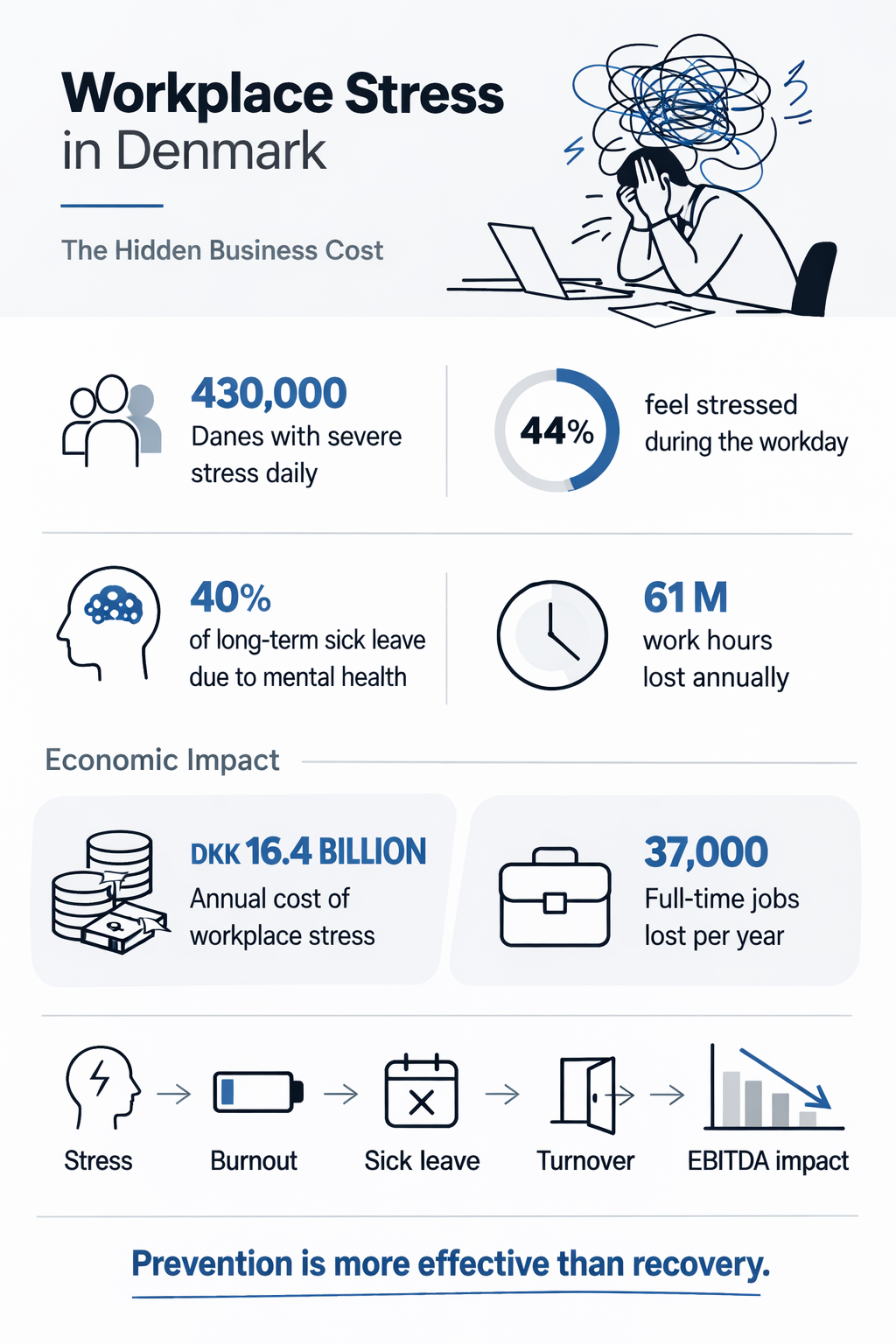
Stress, Burnout, Sick leave isn't an employee's personal problem; it's a direct business loss. Look at the scale of the phenomenon in Denmark:
430,000 Danes experience severe stress symptoms daily.
44% of employees report feeling stressed during the workday.
40% of long-term sickness absence cases are related to mental health.
61 million work hours are lost annually due to stress.
The Economic Impact on Your Business:
DKK 16.4 billion — annual cost of workplace stress in Denmark.
37,000 — full-time positions lost annually due to stress-related absence.
The equation is simple:
Stress → Burnout → Sick leave → Employee turnover → Direct EBITDA impact.
Prevention is significantly more effective than recovery.
We've delivered wellbeing programs for many global leaders.
We understand the specifics of different industries — from pharmaceuticals to technology, from manufacturing to high-intensity sales.
Our Approach — From Reaction to Precision Prevention
Most wellbeing initiatives are generic and ineffective. They offer workshops or "perks" (fruit baskets or gym memberships) without understanding the actual emotional state of employees.
Our approach is built on three principles:
Precise Diagnostics: Assessing the emotional state before any interventions begin.
Targeted Interventions: Support that matches the real needs of different employee groups.
Systemic Change: Integrating wellbeing metrics into leadership KPIs and organizational design.
This allows companies to move from "wellbeing programs" to "precise, evidence-based support" that actually works.
We build the program step by step, based on data.
-
We start with a confidential survey. Our proprietary questionnaire, built on validated psychological frameworks, identifies:
Burnout risk levels
Well-being index
Emotional fatigue and stress patterns
Engagement and resilience levels
Results for the company:
Anonymized wellbeing report.
Emotional health heatmap of the team.
Employee segmentation by wellbeing level.
Clear recommendations for action.
-
Based on the data, we offer not "something for everyone," but targeted solutions for different groups.
Red Zone (High Risk — Burnout)
Individual coaching and mentoring.
Body-based stress regulation practices.
Nervous system recovery techniques.
Nature-based wellbeing sessions.
Goal: Restore emotional balance and prevent long-term sick leave.
Yellow Zone (Moderate Risk — Chronic Stress)
Group mindfulness training.
Meditation and resilience practices.
Art-based reflection workshops.
Practical stress management tools.
Goal: Restore sustainable energy and prevent progression to burnout.
-
From reactive support to systemic change. We don't just run an "event"; we change the approach to work.
What we embed into the company's DNA:
Wellbeing metrics in leadership KPIs.
Training managers to recognize signs of stress (Mental Health Literacy).
Team-level ownership of daily energy.
Organizational design that minimizes unnecessary stress.
Outcome: Wellbeing isn't a program you run. It's how your company operates every day.

ROI of Preventive Wellbeing Programs
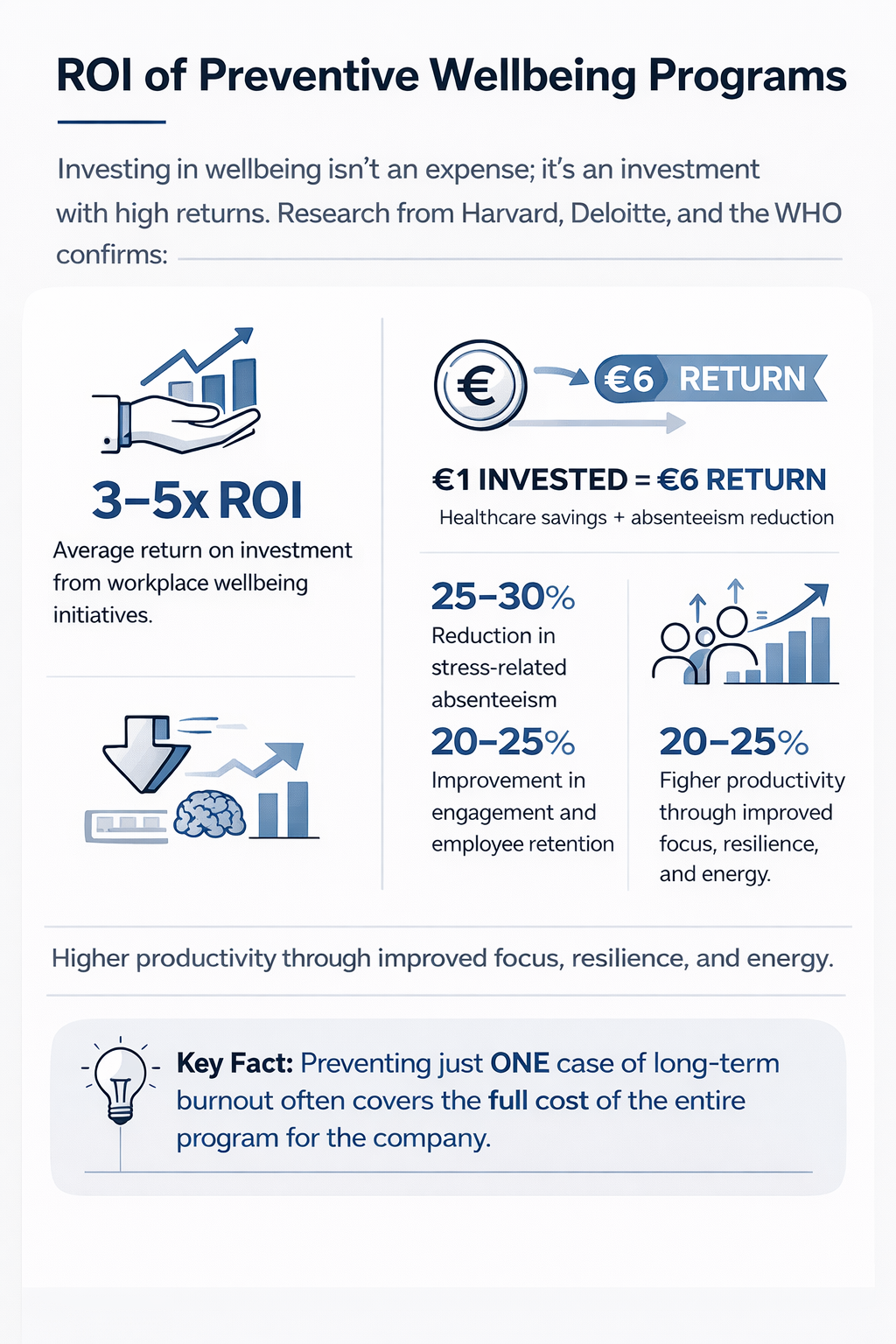
Investing in wellbeing isn't an expense; it's an investment with high returns. Research from Harvard, Deloitte, and the WHO confirms:
3–5x ROI — average return on investment from workplace wellbeing initiatives.
€1 invested = €6 return (healthcare savings + absenteeism reduction).
25–30% reduction in stress-related absenteeism.
20–25% improvement in engagement and employee retention.
Higher productivity through improved focus, resilience, and energy.
Key Fact: Preventing just ONE case of long-term burnout often covers the full cost of the entire program for the company.
Scientific Foundation — Data You Can Rely On
Our Emotional State Assessment is built on validated psychological frameworks, created here in Scandinavia, and adapted for the corporate environment. This isn't a "fortune teller"; it's precise diagnostics.
What We Measure:
Burnout Risk — based on Copenhagen Burnout Inventory — created in Denmark for Danes. Adapted for business.
Emotional Fatigue — based on Maslach Burnout Inventory (global benchmark)
Resilience — based on Connor-Davidson Scale (clinically validated)
Engagement — based on Utrecht Work Engagement Scale
Stress Patterns — based on Perceived Stress Scale (simple and reliable)
Why does this matter? Because you get the rigor of science in a business-friendly format.
The Simplest Way to See the Link Between Wellbeing and Revenue
Want to see our approach in action, without risk and lengthy approvals? Start with the department where emotional state has the most direct impact on results — the sales department.
Why this is the ideal "low-commitment start":
Sales is emotionally intense work: rejections, deadlines, quarterly targets.
Stress levels here fastest convert into lost revenue.
Improving the mental state of salespeople has an immediate effect on conversion.
What you get:
Wellbeing Analytics for Your Sales Team — a heatmap of the emotional state of your key hunters.
A Report with Recommendations — pinpointing where energy is lost and how to bring it back into negotiations.
A Clear Correlation: team morale -> deal volume -> EBITDA.
Pilot Program Proposal
If you want to go further and test the approach systemically, we suggest starting small — a pilot project in one department.
Pilot Structure:
This approach allows you to test the solution with minimal risk before scaling company-wide.
-
Conducting an emotional state survey among employees in the pilot group.
-
You receive an in-depth analysis and a "heatmap" of wellbeing for your department. At this stage, you can stop, get the data, and make an informed decision.
-
Based on the report, we propose a set of tools (coaching, workshops) agreed upon with you.
-
We re-measure the indicators to see progress and the impact on the business.
About Us — Handlemod
Handlemod works with organizations that want to build courageous leadership and healthy workplace cultures.
Our expertise:
Leadership Development
Psychological Safety in Organizations
Coaching and Organizational Transformation
We help leaders and teams tackle difficult challenges, build resilience, and create workplaces where people can thrive and perform sustainably. Our wellbeing programs are grounded in practical leadership experience and proven in international corporations.
Start Building Resilience Today
Healthy employees create resilient organizations.
Companies that invest in wellbeing today build:
Stronger engagement.
Healthier leadership cultures.
Lower absenteeism.
Sustainable long-term performance.
Choose your path:
For quick results: Launch wellbeing analytics for your sales team and see the link to revenue in 2 weeks.
For a systemic approach: Schedule a strategic conversation about a pilot project for your business in Denmark.